I’ll be the first to admit it: I didn’t grow up immersed in technology.
My exposure to computers was limited, and when the internet started becoming a central part of day-to-day life, both in business and personally, I resisted it hard. “Internet? Inter-NOT.” That was my go-to catchphrase in the late ’90s, and I wore it like a badge of honor.
But something interesting happened once I stopped fearing it and started learning it. The more I leaned in, the more I realized technology wasn’t replacing me, it was helping me. My personal life benefited. My professional life benefited. And eventually, I couldn’t imagine working without it.
Fast forward to today, and we’re at a very similar moment with AI.
AI always finds its way into the conversation. Someone says it’s overhyped. Someone else says it’s terrifying. Someone declares it’s “the future.” And somehow, you’re the one expected to know what it is—and explain it.
Here’s the plot twist: most people debating AI are already using it every single day. They just don’t call it that.
AI isn’t one mysterious thing doing one big, scary job. It’s a broad set of tools that handle tasks of all sizes, from simple to complex, helping us get places on time, find answers faster, and avoid thinking too hard before our second cup of coffee.
AI is already in your world (and your dealership)
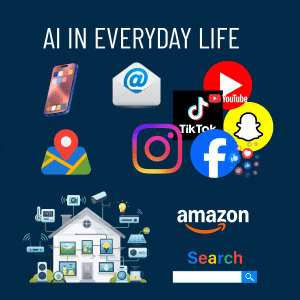
Your phone runs on AI. So do digital assistants, chatbots, social platforms, and search engines. It’s in your car helping you avoid traffic. It’s in your home, quietly powering everything from security systems to robot vacuums that judge you for crumbs you didn’t know were there.
Here’s what that looks like in real life:
- Email: spam filters, spellcheck, grammar tools
- Meetings: transcription and summaries
- Language: translation apps and predictive text
- Search: results that get smarter over time
- Maps & traffic: reroutes before you even see the problem
None of this should feel intimidating. It should feel helpful, because it is. Most of the time, AI is just quietly doing the work that makes everyday life smoother.
And candidly, this is where my own perspective changed again. Just like the internet years ago, AI brought some initial hesitation for me. New technology and new ways of doing things always do. But once I started using it, really using it, every day, that hesitation faded.
To borrow a cliché (because sometimes they’re true), AI has genuinely given me more time back in my day and made me more efficient. Not theoretically. Not someday. Right now.
Bring that mindset into the dealership
Your employees are already using AI. The real question is whether the dealership is guiding how it’s used.
Because without guidance, AI becomes a “choose your own adventure” story—different tools, different outputs, different standards. That can lead to inconsistent customer experiences, avoidable risk with customer data, and missed opportunities to actually save time and grow revenue.
Step 1: Start where the friction is
Before you adopt any AI tool, take a hard look at where your dealership loses time, money, or customers. A quick audit can tell you exactly where AI could help, without disrupting what’s already working.
Ask a few practical questions:
- Where do leads fall through the cracks?
- What tasks consume hours but add little value?
- Where do handoffs between departments break down?
- What questions do customers ask repeatedly that could be answered faster (and consistently)?
This is how you lower the barrier to adoption: target the busywork first.
AI doesn’t replace people. It replaces busywork.
Step 2: Put simple policies in place (so your team isn’t guessing)
If your team is experimenting with tools like ChatGPT, email assistants, AI note-takers, or “smart” CRMs, that’s not a problem. That’s initiative.
What is a problem? No guardrails.
Every dealership should have clear, common-sense guidelines:
- Which AI tools are approved for dealership use?
- What customer data can (and cannot) be entered into AI systems?
- How should AI-generated content be reviewed before it goes out?
- Who owns AI strategy, training, and ongoing improvement?
This isn’t red tape. It’s how you protect customer trust, keep your brand voice consistent, and make sure AI actually improves outcomes. (We’ll be sharing more guidance on AI best practices and policies in a future blog.)
AI can absolutely drive results—but the winners won’t be the dealerships chasing every new gadget. They’ll be the dealerships using AI intentionally to reduce friction, standardize execution, and improve the customer experience across the entire store.
The “why now” (in one stat)
In a survey of dealership decision-makers, 81% said they expect to increase their AI budgets in 2025, and 100% of dealers already using AI reported revenue increases over the past year.
Whether your dealership serves powersports, marine, RV, trailer, or golf, the takeaway is the same: AI adoption is accelerating, and the dealers getting ahead of it are doing so thoughtfully, not impulsively.
Where Lightspeed fits
Lightspeed has been built around dealership operations for decades. That matters, because AI shouldn’t force you to reinvent your processes, it should make the processes you already run faster, cleaner, and easier to manage.
So if your crew is already using AI (they are), the next move is simple:
Coach it.
None of this should feel intimidating. It should feel helpful. Because it is.
AI doesn’t show up with flashing lights and dramatic music. Most of the time, it’s just quietly doing the work that makes everyday life smoother. Once you notice that, the fear tends to fade—and what’s left is a powerful tool you’ve already been trusting all along.
The next step? Simply noticing the tools that already make your work easier and asking:
“Where else could this help?”
AI doesn’t replace people.
It replaces busywork.
And that’s something most of us could use a little less of.
And if you want help turning these ideas into practical next steps, continue to follow the Lightspeed blog as we’ll be posting AI educational blogs each week to help you move “From viewing things in the rearview mirror, to using AI to help you be more efficient” Plus, keep an eye out for our upcoming Lightspeed webinar that will focus on how Lightspeed is innovating to bring even more AI capabilities to your dealership.

Bryan Tierney
Bryan Tierney’s journey with Lightspeed began more than thirty years ago, inspired by a lifelong passion for the Powersports industry. What started with weekends spent at a local motorcycle shop with his father led to his first job behind the parts counter—and ultimately, a distinguished career with Lightspeed. Today, Bryan is a contributor to the company’s daily activity, having authored numerous blogs, presented at major industry events, led webinars, and delivered thousands of product demonstrations. His enduring enthusiasm for the recreation industry continues to drive his work. At home, Bryan, his wife, and their son have built a creative and adventurous family, united by a shared appreciation for learning, exploration, and the occasional ride together.