Because running a dealership is not the same as running a shoe store.
If you’ve ever tried to force a general retail system to behave like a real dealership DMS, you already know how this story ends. Somewhere between VINs, service tickets, flooring statements, and the mystery of where your gross profit went, things get… spicy.
So let’s answer the question dealers ask us all the time:
Is your system actually built for dealerships, or is it just retail software in a “powersports, RV, marine, golf car, trailer” costume?
The Hard Truth
Most “DMS” platforms didn’t start in dealerships.
They started in retail.
Then someone slapped on inventory fields, added a few service screens, and said, “Boom. Dealer software.”
That’s like putting knobby tires on a sedan and calling it a dirt bike. Technically it moves. Practically it’s a mess.
What Dealership-Built Really Means
A true dealership system doesn’t treat your business like a cash register with aspirations. It understands your world out of the gate.
Here’s what that looks like.
Major Units Aren’t Just Inventory
Your system should speak fluent VIN and HIN, not Google Translate.
Lightspeed tracks:
- VIN/HIN decoding
- OEM integrations and major unit imports
- Floorplan aging, payables, curtailments, and flooring statements
This isn’t retail math. It’s dealership survival.
Service Drives Revenue (If Your System Lets It)
Retail software treats service like a side quest.
Dealership software makes it a main storyline:
- RO workflows designed for techs, not cashiers
- Flat rate, warranty, customer-pay, and internal work tracking
- Service scheduling, parts availability, and technician efficiency metrics
If your service department lives in spreadsheets, it’s not a people problem. It’s a system problem.
Your Accounting Isn’t a “Nice-to-Have”
General retail systems bolt accounting on later. Like an afterthought.
And then they tell you to “just export it to QuickBooks and fix it there.”
A dealership-built DMS doesn’t treat accounting like a side hustle.
Lightspeed:
- Handles flooring, prepaids, COGS by department, and inventory capitalization natively
- It can deliver QuickBooks-level accounting out of the box — or takes you far beyond it with fully integrated dealership accounting
- Keeps your books dealership-clean, not retail-cute
- Doesn’t require a full moon and three workarounds to close the month
Your accountant won’t just notice.
They’ll stop calling you at 8pm.
Reporting That Doesn’t Make You Cry
Retail systems brag about sales totals.
Dealerships need clarity.
Lightspeed reporting is built around the questions dealers actually ask:
- Where am I making money?
- Where am I bleeding it?
- Which departments are carrying the load?
- Which techs, advisors, and processes are driving real profit?
This is visibility you can run a business on. Not just stare at.
So… Which Kind of System Do You Have?
If your DMS was born in retail, you feel it every day:
- Workarounds.
- Duplicate entry.
- “That’s not how dealerships work” moments.
- And that low-grade frustration that never fully goes away.
If your system was built by people who ran dealerships?
You stop fighting the software and start using it.
The Bottom Line
Dealerships are complex. On purpose.
You are not cookie-cutter, so your software shouldn’t be either.
Your system should respect that complexity, not water it down and definitely not try to cram your operation into a generic retail box.
Lightspeed wasn’t adapted for dealerships.
It was built by dealers, for dealers and it’s why so many choose Lightspeed as the best software for running a modern dealership.
And we’re not standing still. We’re constantly improving, innovating, and rolling out smarter integrations that help you run faster, cleaner, and more profitably every year.
Once you run a system that actually understands your business…
you won’t settle for retail in disguise ever again.

Lightspeed
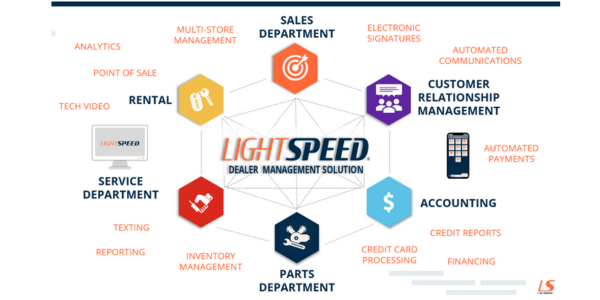
Lightspeed is a leading provider of cloud-based software for dealerships and Original Equipment Manufacturers (“OEMs”), serving the Powersport, Marine, RV, Trailer, Outdoor Power Equipment, and Golf Car industries. Lightspeed’s Dealer Management Solution (DMS) enables dealerships to optimize their end-to-end business operations, including sales, parts, service, rental, accounting, and CRM. When implemented into their daily operations, Lightspeed helps dealers increase their profitability by selling more units, service, and parts, all while creating a more streamlined experience for customers. For more than 40 years, Lightspeed has been empowering 4,500+ dealers across North America with the tools and technology they need to manage their dealerships. For more information, visit www.lightspeeddms.com.